






































 Shopping guides
 Help
 Log in

What is better for working: white light or yellow light?
Article index
Discover here what are the advantages and disadvantages of working with white light or yellow light in your work environment. See what suits you best when it comes to being more productive.
When it comes to improving our productivity, there are many factors to consider that can positively or negatively affect our attention capacity.
In fact, humans right now have a lower capacity for focus and concentration than our ancestors did, mainly due to our greater exposure to distracting elements.
Factors such as a constant bombardment of advertising, the intrusion of technology into our daily lives, and receiving thousands of stimuli like notifications or calls cause our attention to be constantly scattered.
Thus, it is important that, being aware of this problem, we try to remedy it through methods or concentration techniques at work.
One of the elements that precisely affects our concentration and that you would never think of first is nothing more and nothing less than the lighting of our environment.
How does lighting affect our work? In many ways:
- in mood;
- in visual comfort;
- in our productivity;
- in our physical and mental health.
That’s why a room lit with white or yellow light affects your work performance more than you might think. Therefore, here we will tell you what the advantages and disadvantages are of working with white or yellow light and how you can make the most of it.
What is "white light"?
To define white light or yellow light, we first need to talk about the so called colour temperature.
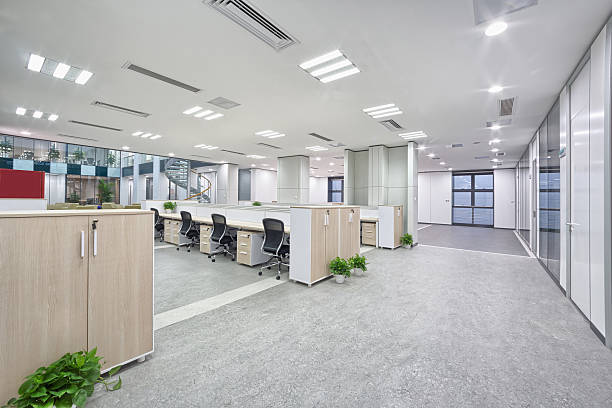
What is colour temperature?
It is basically measuring the predominance of one of the colours in the light spectrum over the others. That is, white light (or the absence of color) tends towards red or blue in that light spectrum.
As an example, we can take two moments of the day: sunset and sunrise.
At sunset yellow colours of the sun weaken towards the blue of the night, while at sunrise the opposite occurs: colours become orange, signaling the start of a new day.
In each of those moments, we can say that the predominant colour is blue (at sunset) and yellow-reddish at sunrise. This, in chromatic terms, means that one will tend towards cooler colours (the blues) and the other towards warmer ones (reds, yellows, or oranges).
Although it may seem subjective, this is actually a measurement scale that is regulated in Kelvin (with the symbol K). If the colour temperature measures more than 5000 K, it is a cool colour, tending towards blue, while if it measures between 2200 - 3500 K, it is a warm one, tending towards yellow. This is why cool lights have bluish and white colour, while warm lights show more yellowish and orange tones.
What is then the white light? It is the one whose temperature is from 3500K onwards. Here, in fact, we can distinguish two types:
- neutral white light: the one that is between 3500K and 4500K. It is a pure white light, more versatile, and is widely used in shopping centers and homes (mainly kitchens, bathrooms, or studies).
- cool white light: it is the one that is between 4500K and 6000K. This type of light has a more bluish tone, making it appear much more aggressive due to the power it generates.
Advantages and disadvantages of white light for work
When judging whether white light or not is more suitable for performing our daily tasks, we must highlight the following points:
- neutral white light is more standard and less aggressive, which will make you strain your eyes less. If you are working in a more multipurpose space, where besides working you will have meetings or workshops, this option is the most suitable because it is more adaptable. However, your concentration capacity will be more diminished.
- cool white light is more specific and more powerful. It is perfect for a study or exclusive work area because it facilitates concentration more by having a greater visual spectrum to avoid straining your eyes. On the contrary, you must ensure that this light does not shine directly on you, but is positioned transversely so that your eyes do not suffer.
What is yellow light?

Continuing with what we have discussed, yellow light is that whose visual spectrum is below 3500K. In this sense, we can once again distinguish two types of yellow light:
- warm light: the one that is between 2200K and 2700K. It is pure yellow light, with a very powerful warmth effect.
- warm white light: it is between 2700K and 3500K, less powerful in warmth than the previous one, but with a very noticeable yellow tone.
Advantages and disadvantages of yellow light for work
In reality, both warm light and warm white light are more focused on creating an environment of relaxation, comfort, and peace. It is not the most suitable for workspaces where you need to be more alert to perform your tasks, but rather they are more thought out for waiting areas, reading corners, bedrooms, and, ultimately, any place where the focus is on leisure and tranquility rather than work.
Why is this so? Because blue light affects our circadian rhythms and the generation of cortisol, the stress hormone.
In fact, this is one of the main reasons why it is recommended to reduce the colour temperature on screens as night approaches so that it does not affect our sleep rhythm while we check our mobile phones. So, the more blue light, the more alert and focused you will be for your tasks.
Has this information about working with white or yellow light been useful to you? Remember that at Officechair365 we have a wide selection of office chairs, computer chairs, and ergonomic options designed exclusively to further enhance your productivity.
Visit us now at the Officechair365 website and enjoy all our offers. We are waiting for you!


