













 Shopping guides
 Help
 Log in

8 exercises to do while seated
Article index
Seated exercises can be a great help when you have to spend many hours in the office without moving. This way, you will take care of your back and avoid many discomforts.
Are seated exercises useful?
Exercising is a part of the healthy lifestyle, it is important to maintain balanced productivity, concentration, and creativity. It helps to improve physical and mental health of workers, and beyond keeping them fit, it is necessary to strengthen muscles and extend their quality of life. It has been proven that people who exercise have more energy, are happier, and more productive. They also develop better interpersonal relationships. However, we know that this can be something difficult to practice in case of those who spend most of the day working. Therefore, office exercises can be very useful.
Working is a big part of our daily routine, it allows us to pursue our passions and cover our expenses. Regardless of whether we work from home or in the office, sitting is almost a rule, because most activities take place on a laptop. When you have work or study tasks to complete, the only exercise you do is the rush and sprint you make in the morning to arrive on time.
During the day, it is difficult to find a moment to train, and especially the energy needed to perform activities that require a certain caloric deficit. Seated exercises can be the solution.
A sedentary lifestyle affects the quality and style of people's life, especially those used to staying active and in constant motion, such as runners, gymnasts, or gym enthusiasts. For the weeks when you hardly lift your eyes from your desk, we propose eight seated exercises that can help you get active.
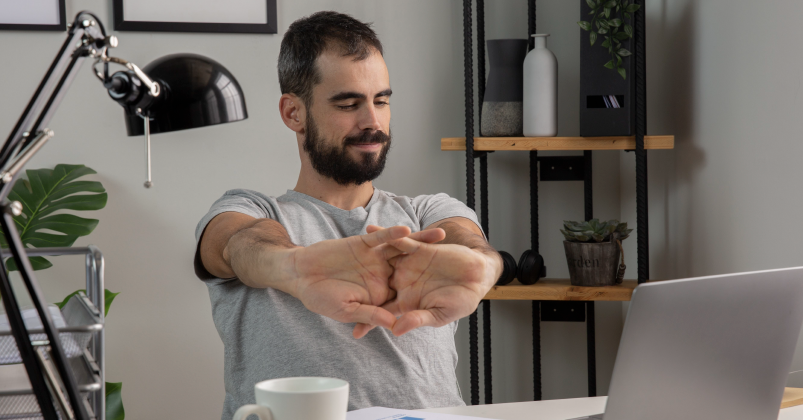
1. Abdominal exercises
Previously, we mentioned in our article about postural recommendations that keeping the abdomen tight for certain periods of time is important to avoid disc hernias. Therefore, it is possible to do simple abdominal exercises while sitting, without the need for sudden movements or stretches. You just need to pull in your abdomen and count to twenty seconds.
To see results in a matter of weeks, it is recommended to do this at least twenty times a day. You should not exert force, and even less expect magical results, as the process is slower than going to the gym, but it is fantastic for strengthening the torso.
2. Leg extensions
To improve blood circulation, a good idea is to elevate your legs in the air, all from the comfort of your chair. First, one leg at a time, calmly and without making sudden movements, until you align the instep, the rest of the leg, and the knee. Hold the movement for a few seconds and lower carefully, to repeat the exercise with the other leg.
With these seated exercises, we will specifically work on the quadriceps. The legs are the parts that suffer the most from the inactivity of sitting all day. That’s why our circulation can be affected, and we may have problems like varicose veins or a tingling sensation in some areas.
3. Seated exercises: adduction
It is appropriate to work the glutes and adductors, and although it may seem incredible, it is extremely simple to do from the comfort of your seat.
For the first exercise, you only need to find a sturdy book like encyclopedia, or even a water bottle, and place it between your thighs. Then, squeeze and bring your legs inward for thirty seconds. The point of this exercise is to press as if you want to crush something with your thighs working with the adductors. As you progress, you can do two sessions, with ten seconds of rest in between.
Another way to work is to do the opposite, that is, push your knees outwardly with the palms of your hands. Slowly! We want to achieve results and not get injured. These are simple seated exercises that will help make your workday more bearable and your muscles will feel better.
4. Contractions
Glute contractions are also a good option for exercising while sitting at work. They help improve blood circulation and make our legs and muscles firmer. You can do three sets of ten repetitions, and you don’t need to exert force, just relax and do the exercise at your own pace.
5. Push-ups
Now that we have completed a cycle of seated exercises, it is necessary to stretch our body a bit. If you are alone in the office for a while, you can warm up by shaking your arms with calculated and slow movements. Then, you just need to stand up straight, with your muscles relaxed, and clap your palms against the wall. The weight will make you bounce gently, and you will be able to work on your upper body, arms, and their strength.
6. Seated exercises: neck
We cannot neglect the cervical area, which is often affected by tensions and injuries like a heavy neck strain. Just remember to consult your doctor if you suffer from chronic problems, as under certain health conditions, their supervision is essential for you to perform certain exercises. You should sit at the edge of the chair and relax your joints, then move your head side to side, up and down, and in circular motions. Slowly and carefully!
The exercises to do on a chair are also the perfect moment to breathe deeply and relax for a few seconds. This will help you improve concentration and focus better on the work you are doing at that moment.

7. Joint mobility exercises
To work on the joints, there are also practical exercises you can do from your chair. One option to strengthen and protect your ankles is to rotate them in circular movements for one minute each, it will prevent sprains and accidents in the workplace. You can also sit at the edge of the chair and pass your arm over your shoulder as if you want to touch the center of your back. With the other hand, gently hold it for twenty seconds, and then do the same with the other arm.
8. Seated exercises: rotations
To have a stunning waist and enough strength in your trunk, you only need to do rotations. This exercise is phenomenal because you can move your trunk slowly, from side to side, for one minute and achieve excellent results.
What you need to keep in mind when doing seated exercises
Before starting seated exercises, keep these recommendations in mind to ensure their effectiveness and avoid injuries:
- Correct posture: Keep your back straight, shoulders relaxed, and feet flat on the ground.
- Space ergonomics: Adjust your chair and desk to the appropriate height. An ergonomic chair is essential.
- Gentle movements: Perform the exercises slowly and in a controlled manner to avoid injuries.
- Proper breathing: Breathe deeply to oxygenate the muscles and improve performance.
- Hydration: Drink water regularly to keep the body in optimal condition.
- Regular breaks: Get up and walk every hour to improve circulation and avoid stiffness.
- Medical consultation: If you have any medical condition, consult a professional before starting.
- Gradual progression: Increase the intensity of the exercises gradually to avoid overexertion.
- Comfortable clothing: Wear clothes that allow you to move freely.
- Positive attitude: Maintain a motivated attitude focused on the benefits.
There is a wide variety of seated exercises that will help you make the office hours more bearable. They will also help to improve concentration and make you feel more active and vital.
What do you think of these seated exercises? We hope you put them into practice! Remember to organise your office so that you have enough space to move and do exercises during the workday. And that a good ergonomic chair can also be a great help to avoid many of the discomforts associated with sedentary life in the office.


