



















 Shopping guides
 Help
 Log in

What is lean office and how to apply it to office work
Article index
When we hear about “Lean” we usually think of factories, production lines and industrial processes. However, this philosophy of continuous improvement can also be applied to administrative environments. This is where the concept of Lean Office comes from, a way of organising and managing work in the office with the aim of eliminating waste, optimising processes and improving productivity at work.
Lean Office is not a passing trend, but an adaptation of Lean principles to management tasks, customer service, project coordination or any office process. And the best part: it does not require large investments, but rather a change in mindset and habits. We tell you more in this article.
What is lean office
Lean Office is the application of the Lean philosophy —originated at Toyota— to the administrative and office field. Its main objective is to identify and eliminate everything that does not add value for the customer, whether internal (colleagues, departments) or external (clients, suppliers). Unlike Lean Manufacturing, which focuses on machines, production lines and physical products, Lean Office focuses on the flows of information, documents, emails, approvals, meetings and any process that may generate a waste of time or resources.
Implementing Lean Office means carefully analysing how each task is carried out, from the arrival of a document to its final approval, and constantly asking yourself: does this add value or can it be simplified/eliminated? This includes processes such as handling requests, filing information, coordinating projects or even organising meetings, always seeking efficiency without sacrificing quality.
In this sense, it complements naturally with other time management methods, such as the pomodoro work method, the GTD (Getting Things Done) technique or the Pareto 80/20 rule. All of them pursue the same goal: reducing distractions, eliminating unnecessary activities and increasing focus on what really matters. For example, combining Lean Office with block-based work sessions allows teams to prioritise high-value tasks, minimise interruptions and gain productivity without increasing the workload.
By applying these principles, offices become not only more efficient, but also more organised and pleasant for those who work in them, creating an environment where every minute counts and every effort has a clear purpose.

How to apply lean office to office work
Putting Lean Office into practice means reviewing office processes with a critical eye. Here are the main ideas to start applying it:
Eliminate waste
The first step is to identify activities that consume time and resources but do not add value. Examples: unnecessary approvals, duplication of tasks or printing documents that could be digital. Reducing this waste frees up capacity and makes processes more agile.
Standardise processes
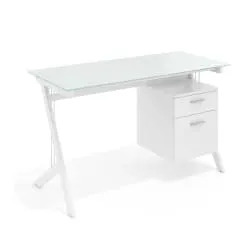
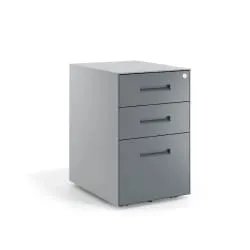
When each person carries out the same procedure differently, errors and delays appear. Documenting and standardising common tasks —such as how to reply to an email or how to register an order— saves time and avoids confusion. Having organised furniture helps here, such as a well-structured desk drawer unit, which makes it easy to find what you need in seconds.
Visualise the workflow
Using visual boards, whether physical or digital, allows you to see the status of each task. This reduces the need for constant meetings and improves coordination between departments. A simple “to do – in progress – done” board already brings clarity.
Reduce waiting times
Waits in administrative processes are one of the biggest forms of waste. Reviewing bottlenecks and defining clear responsible parties helps procedures move forward faster. It is also advisable to use digital tools that automate reminders and approvals.
Optimise the workspace
Physical order also influences efficiency. An office crammed with papers and objects generates distractions and slows down work. Investing in functional furniture, such as an ergonomic office chair and well-placed shelving, improves comfort and encourages concentration.
Drive continuous improvement
Lean Office is not implemented once and that is it. It is a culture in which teams periodically review their processes, detect problems and propose solutions. Continuous improvement is the heart of the Lean philosophy.

Practical examples of Lean Office
To better understand how to apply this philosophy, let us look at some concrete examples:
- Document management: moving from physical archives to collaborative digital platforms reduces search times and prevents losses.
- Efficient meetings: setting a maximum duration, defining a prior agenda and recording clear agreements avoids long and unproductive meetings.
- Customer service: centralising information in a CRM system prevents employees from having to ask several colleagues to resolve a query.
- Approval processes: reducing hierarchical levels and automating low-risk approvals speeds up projects.
- Employee onboarding: having a standardised procedure speeds up the integration of new hires.
Advantages of applying Lean Office
Adopting Lean Office in your office brings benefits that go beyond efficiency:
- Time savings: fewer unnecessary steps and more focus on what is important.
- Cost reduction: by eliminating waste, spending on paper, printing, energy and unproductive hours is reduced.
- Improved work environment: teams feel more comfortable working in tidy environments without administrative obstacles.
- Greater customer satisfaction: by speeding up processes, the customer receives faster responses and a better service.
- Greater flexibility: by standardising processes, it is easier to adapt to changes or integrate new technologies.
A more efficient office
Lean Office is a philosophy that seeks to apply efficiency and continuous improvement in the administrative field. It does not require large investments, but rather changing the way we see processes and eliminating everything that does not add value. Through standardisation, workflow visualisation, the reduction of waits and the organisation of space, your office can be more agile, productive and motivating. If you want to take the first step, start with small improvements: a shorter meeting, a visual board or a simple reorganisation of documents. Little by little, you will build a Lean culture that will make your office work better for everyone.


