













 Shopping guides
 Help
 Log in

At what height to hang a picture depending on its size and the room
Article index
Hanging a picture seems like the final gesture of any decoration. The last touch. The detail that “rounds off” the wall. However, placing it a few centimetres too high or too low is enough for something to stop fitting, even if we do not know exactly what.
Height matters much more than we think. It can slim down a room or throw it off balance, make the ceiling look higher or leave the wall looking bare. And the curious thing is that it does not depend only on personal taste: the size of the piece, the type of space and the furniture around it all come into play.
Dressing the main wall of a living room is not the same as giving character to a narrow hallway or adding personality to a professional office. In each case, the decision changes… and quite a lot. So, at what height should you hang a picture? Keep reading, because the answer is more interesting than you imagine.
How to know at what height to hang a picture in each case
To determine at what height pictures are hung correctly, there is a general rule that serves as a starting point: the centre of the picture should sit approximately 145-150 cm from the floor. This measurement matches the average eye height and ensures comfortable viewing.
That said, this rule is not rigid. It is a base that must be adapted according to the type of room, the size of the work, the height of the ceilings and the furniture surrounding it. The key is to understand that a picture is not hung “on the wall”, but within a specific visual context.
Below, we look at how to adjust that measurement in different scenarios.

Height for pictures in the living room
The living room is usually the space where pictures take the most prominence. They are commonly placed above the sofa, a console or on a main wall that acts as a focal point.
If the picture goes above the sofa, besides respecting the 150 cm reference to the centre, it is essential to look after the distance from the backrest. It is advisable to leave between 15 and 25 cm from the bottom of the frame to the top of the sofa. This gap creates a clear visual connection and prevents the picture from looking disconnected or “too high”.
Another important aspect is proportion. The width of the picture (or the set of pictures) should take up approximately between 60% and 80% of the width of the sofa. If it is much smaller, it will get lost. If it is too large, it will overwhelm the space.
In living rooms with high ceilings, the height can be adjusted slightly, but without falling into the mistake of bringing it too close to the ceiling. The furniture remains the main reference.
Recommended height for pictures in offices
The recommended height for pictures in offices must take into account the functionality of the space. In a professional office, pictures are usually placed behind the desk or in waiting areas.
If the picture is placed behind your desk, it should be centred with respect to the furniture and its lower part should not sit too high. Ideally, keep the 145-150 cm reference to the centre, adjusting according to the height of the furniture.
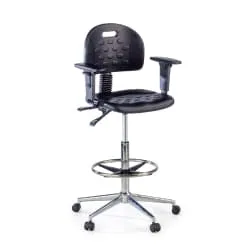
In spaces where people work seated for many hours, where it is advisable to use an ergonomic chair, it is important that the picture stays within the natural field of vision when looking up, avoiding forcing the neck upwards.
Furthermore, in corporate environments it is advisable that pictures are aligned with each other if there are several on the same wall, reinforcing an orderly and professional image.
At what height to hang a large picture
When we talk about large-format pictures, the visual effect changes completely. These pieces usually become the focal point of the room and carry more decorative weight.
The rule of the centre at 150 cm still applies, but in some cases it can be adjusted slightly to balance the visual impact. In wide spaces or with high ceilings, raising it a few centimetres can work, as long as the relationship with the furniture is not lost.
A common mistake is hanging large pictures too high for fear that they will “invade” the space. The result is usually the opposite: the wall ends up fragmented and the whole becomes unbalanced. Large pieces work better when they integrate visually with the elements beneath them.
It is also worth bearing the frame in mind. A wide frame or one with a mount visually increases the total size of the piece, something that influences the final perception of the height.

Height for small pictures or compositions
When we talk about small pictures or wall galleries, the criterion changes slightly. Instead of measuring each picture individually, the set should be considered as a single composition.
The visual centre of the group should sit approximately at eye height (145-150 cm). To achieve this, it is advisable to lay out the composition on the floor before fixing it to the wall and measure the central point of the set.
This type of arrangement is very common in modern decorative styles. If you want to delve into current trends, you can check out different decoration styles and adapt them to your space.
At what height to hang a picture in hallways
Hallways present a different challenge: the point of view is in motion. Here, uniformity is essential.
Keeping the centre of the pictures around 150 cm helps generate visual continuity. If several are placed in a line, it is advisable to trace an invisible horizontal guide that they all respect, whether by the centre or by the top.
In narrow hallways, it is preferable to opt for vertical or medium formats, placed at a slightly more contained height so as not to visually overwhelm the space.
Height of the picture over auxiliary furniture
When the picture is placed over a console, a sideboard or a low piece of furniture, the distance should be smaller than on a completely free wall.
Ideally, leave between 10 and 20 cm from the top of the furniture to the bottom of the frame. This way, both elements are perceived as an integrated whole and not as independent pieces.
If decorative objects are also placed on the furniture — vases, lamps, books — it is advisable to take their total height into account so that they do not interfere with the work or break the proportion.
Common mistakes when hanging pictures
One of the most frequent mistakes is not measuring before drilling. Another very common one is taking the ceiling as a reference instead of the furniture, which usually causes the pictures to end up too high.
It is also common to ignore the proportion with respect to the wall. A small picture centred on a very large wall can look lost, even if it is at the correct height.
And, of course, there is the failure of not taking the surroundings into account. A picture is not an isolated element: it must dialogue with sofas, desks, consoles or chairs so that the whole works.
In short, knowing at what height to hang a picture is not about applying a fixed figure, but about starting from a reference — the centre at 145-150 cm from the floor — and adapting it with judgement to each situation. When proportions, furniture and context are balanced, the difference is immediately noticeable in the harmony of the space.


